Silogism is a form of reasoning in which a conclusion is drawn from two given or assumed propositions (premises), leading to a logical deduction. This insightful guide delves into its origins, applications, and relevance in modern thinking. Silogism has been a fundamental aspect of logical reasoning and philosophical discourse for centuries, providing a structured way to assess arguments and derive conclusions.

Silogism is a foundational element of logic that underpins much of Western philosophical thought. It involves a form of deductive reasoning through which a conclusion is drawn from two premises. This ancient method, developed by Aristotle, plays a crucial role in the structure of logical arguments, often forming part of advanced studies in philosophy, rhetoric, and computer science. By understanding silogism, one can grasp the principles of logical discourse, engage in effective argumentation, and apply rational analysis to various fields of human inquiry.
Originating with Aristotle in ancient Greece, silogism was first articulated in his works on logic, particularly in "Prior Analytics." Here, Aristotle laid out a comprehensive framework for deductive reasoning, establishing rules and structures that would influence scholars for millennia. The basic form involves a major premise, a minor premise, and a conclusion, thus illustrating a clear pathway from general to specific truths. Aristotle’s approach was revolutionary; he organized syllogistic reasoning into a systematic framework that set the stage for future inquiries into logic and reasoning.
Aristotelian logic not only established syllogism as a key area of study but also shaped the disciplines of science, ethics, and metaphysics by providing a formal structure through which truths could be analyzed and compared. The subsequent development of syllogistic reasoning found expression in the works of later philosophers, such as the Stoics and Medieval Scholastics, who expanded upon Aristotle's ideas, increasing the complexity and depth of logical reasoning.
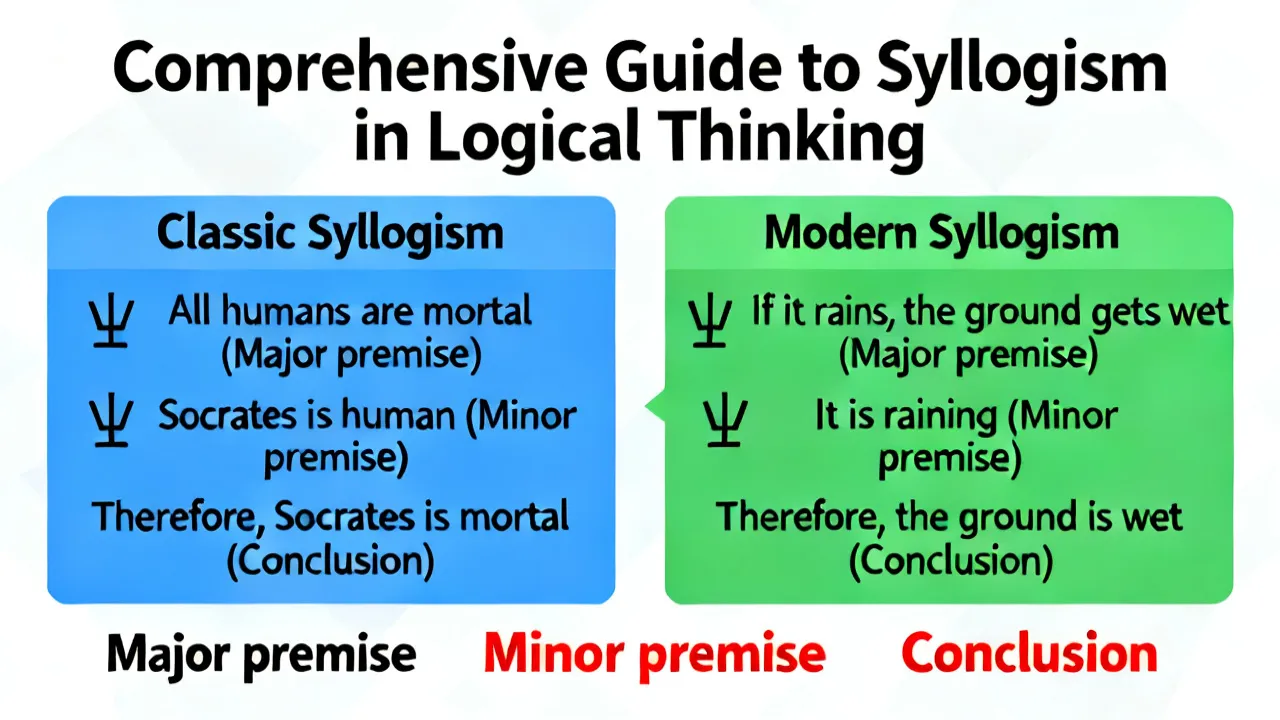
The typical form of a silogism is structured as follows:
| Component | Description |
|---|---|
| Major Premise | A general statement or universal truth. E.g., "All humans are mortal." |
| Minor Premise | A specific statement that relates to the major premise. E.g., "Socrates is a human." |
| Conclusion | A logical deduction derived from the premises. E.g., "Therefore, Socrates is mortal." |
This format can be expanded further with additional premises, leading to more complex forms of reasoning, such as categorical syllogisms and conditional syllogisms. An example of a categorical syllogism could include:
In addition to the basic structure, the quality of the premises is critical. They must be true for the conclusion to be valid. If a major premise is flawed or incorrect, any conclusion drawn from it becomes questionable. This underscores the necessity of critical evaluation not just of conclusions but of the premises themselves.
Despite its ancient origins, silogism remains relevant today. In modern contexts, it's critical in developing algorithms, contributing to artificial intelligence, and aiding in complex decision-making processes. Logic programming languages and even legal reasoning employ its structured approach, showcasing its enduring importance. For instance, in artificial intelligence, systems often use syllogistic forms to build reasoning mechanisms that allow computers to make inferences based on a set of rules and known information.
Moreover, legal argumentation often relies heavily on syllogistic reasoning to draw conclusions from established laws and previous rulings. For example, lawyers present a major premise based on the law, followed by a minor premise concerning the specifics of a case, leading to a conclusion about the case's outcome. This methodological approach helps ensure that judgments are consistent and grounded in established legal principles.
In the realm of education, educators utilize syllogism as a teaching tool, demonstrating how structured reasoning can clarify complex subjects and enhance understanding. In teaching students critical thinking and logic, syllogism serves as an accessible entry point into rigorous analytical thinking.
Educators use silogism to teach students about critical thinking and the logical structuring of arguments. It serves as a tool to enhance cognitive abilities, enabling learners to dissect arguments, identify fallacies, and construct well-founded conclusions. Mastery of this technique is considered a hallmark of advanced critical analysis skills. By training students to form and evaluate syllogisms, educators foster an environment ripe for intellectual engagement and debate, promoting the development of a rigorous thought process.
Beyond teaching basic syllogisms, educational programs often introduce students to more advanced forms or variations, such as disjunctive syllogisms (which involve "either/or" statements) and hypothetical syllogisms (which involve conditional "if-then" statements). Such complexities prepare students for real-world logical challenges they may encounter in fields like law, philosophy, and science.
Furthermore, classrooms that prioritize logical discourse offer students the chance to engage in Socratic questioning—an interactive teaching method that hinges on asking probing questions to stimulate critical thinking and illuminate ideas. This method aligns closely with the principles underlying syllogistic reasoning, affirming its relevance in contemporary educational practices.
Even seasoned logicians sometimes fall into the trap of logical fallacies due to misunderstandings of silogism. Common missteps include affirming the consequent or denying the antecedent, which can lead to flawed conclusions. For example, assuming that if "if P then Q" is true, that P must be true because Q is true is a classic example of affirming the consequent, which is logically invalid. Thus, a thorough comprehension of its principles is imperative for accurate logical analysis.
Another frequent error is the fallacy of equivocation, wherein a word is used with different meanings in different premises, leading to misleading conclusions. Understanding the nuances of language and ensuring precise definitions in premises enhances clarity and validity in arguments.
Additionally, overlooking the necessity of truth in premises can mislead individuals to formulate faulty conclusions based on incorrect or unverified information. It's crucial to critically assess assumptions and ensure they hold true before drawing conclusions.
Lastly, engaging in cherry-picking evidence—which involves selecting only the premises that support one’s conclusion while ignoring contrary evidence—can distort logical reasoning. This highlights the importance of a balanced and open-minded approach to logical analysis, where one must consider all evidence before concluding.
Silogism represents a timeless aspect of logical reasoning, bridging ancient philosophy with contemporary cognitive science and decision-making. Its historical significance and modern applications highlight its utility and importance as a vital intellectual tool. As society continues to evolve, the principles of silogism will undoubtedly remain relevant in cultivating rational thought, guiding effective problem-solving, and fostering informed discourse. This continued relevance speaks not only to the power of logical deduction but also to human beings’ enduring quest for understanding and meaningful communication within an increasingly complex world.
In a digital age inundated with information and competing narratives, the ability to employ syllogistic reasoning equips individuals with a framework to navigate complexities in various contexts. This includes not only academic pursuits but also everyday interactions where evaluated reasoning can clarify discussions and mitigate misunderstandings. Ultimately, by appreciating the role of silogism, we embrace a crucial aspect of human intellect, fostering a society that values logic, reason, and critical discourse.
Striking the Perfect Balance: Navigating Premiums and Out-of-Pocket Expenses in Senior Insurance Plans

Explore the Tranquil Bliss of Idyllic Rural Retreats

How to Make Lasting Memories at Disneyland Attractions

Affordable Phones and Plans for Seniors

Affordable Full Mouth Dental Implants Near You

Unlock the Top Kept Secrets to Finding Your Ideal Dentist for Flawless Dental Implant Results!

Discovering Springdale Estates

The Guide to Car Trading

Affordable Cell Phones Without Plans


Understanding the Art of Silogism
Silogism represents a form of logical reasoning where conclusions are drawn from two or more propositions. Originating from Greek philosophy, it’s pivotal in analytical disciplines and cognitive science, allowing for structured argumentation and critical thinking. This article explores its applications, importance, and how it forms the foundation of logical analysis in various fields.
The Art and Science of Silogism
Silogism is an essential concept in logic that plays a crucial role in reasoning and argumentation. This article examines the foundations of silogism, exploring its historical significance and contemporary applications. By understanding its structure and function, readers can enhance their critical thinking and analytical skills. Discover how silogism underlies many logical deductions and how it continues to influence modern thought processes.

Understanding the Concept of Silogism
This guide delves into the concept of silogism, a form of logical reasoning that involves drawing conclusions from two given or assumed propositions (premises). Originating from the works of Aristotle, silogism has long been a foundational element in the study of logic and philosophy, emphasizing the deductive reasoning process that bridges logical thought with practical applications.

Understanding Silogism in Logic
This article explores the concept of silogism, a form of reasoning in logic. Silogism involves drawing conclusions from two premises, ensuring deductive reasoning is implemented in analytical processes. Understanding silogism is essential for enhancing critical thinking and decision-making abilities across various fields, from philosophy to computer science.

Unraveling the Concept of Silogism
Silogism represents a foundational element in the realm of logic, forming a vital component of deductive reasoning. Originating from ancient Greek philosophy, it serves as a method for drawing conclusions from given premises, a practice essential for coherent discourse and argumentation. Understanding silogism enhances critical thinking skills, providing a rigorous framework for evaluating the validity of arguments across various disciplines.
Understanding the Art of Silogism
Silogism is a form of reasoning in which a conclusion is drawn from two given or assumed propositions (premises), leading to a logical deduction. This insightful guide delves into its origins, applications, and relevance in modern thinking. Silogism has been a fundamental aspect of logical reasoning and philosophical discourse for centuries, providing a structured way to assess arguments and derive conclusions.